Korean Resume Guide 2026: Format and Banned Questions
What a Korean resume contains, the items employers cannot require under the Fair Hiring Procedure Act, where blind-hiring guidance goes further, and how to write the self-introduction.

By the SkillRoute Editorial Team · Last updated October 25, 2026
These guides are for educational purposes and do not constitute legal or immigration advice.
- Korea's Fair Hiring Procedure Act bars employers from requiring your height, weight, birthplace, marital status, property or relatives' jobs. The exception is a job that truly needs it.
- The Act covers employers with 30 or more staff, the state and public bodies. A breach can bring a fine of up to ₩5 million.
- Government fair-hiring guidance builds the form around training, qualifications and experience. Build your resume the same way.
- Never state anything false: the Act itself forbids applicants from falsifying hiring documents.
Most Korean resume guides hand you a template and a list of habits. This one starts from the rules of the hiring process. They decide what you must write and what you may leave out.
Every rule below comes from a Korean government page or the statute, checked on 25 October 2026. Disclosure: this guide names no employer or recruiter, and SkillRoute lists no jobs. Layout advice is marked as our reading.
What does a Korean resume contain?
Our reading, not an official finding: many Korean employers send their own application form (입사지원서). Look for it first. The government guidance says what the form should cover.
입사지원서에는 직무와 관련한 교육·훈련, 자격 경험(경력) 중심으로 항목 구성 (Build the form around job-related training, qualifications and experience)
That gives three core blocks. Photos, age and family details sit outside them, and the sections below show where the rules draw the line.
How should you lay out the document?
Follow the employer's fields in their order. With no form, use the blocks below. This layout is our reading, built from the NCS guidance.
| Block | What to put in it | Basis |
|---|---|---|
| Education and training | Degree, major, courses, each with month and year | NCS: 교육·훈련 |
| Qualifications | Licences and test scores, such as TOPIK, with the date earned | NCS: 자격 |
| Experience | Employer, job title, dates, duties and one checkable result | NCS: 경험(경력) |
| Self-introduction (자기소개서) | Why you fit this job, tied to the three blocks above | Our reading |
What can an employer not ask on a Korean resume?
Article 4-3 of the Act bars employers from requiring information the job does not need. The ban names three groups: physical condition, origin region with marital status and property, and relatives' details.
수집·요구가 금지되는 개인정보는 ① 용모·키·체중 등의 신체적 조건 ② 출신지역·혼인여부·재산 ③직계 존비속과 형제자매의 학력·직업·재산이 해당된다. (Banned: 1. physical condition, such as looks, height, weight; 2. origin region, marital status, property; 3. relatives' education, job, property.)
| Banned item | What it covers |
|---|---|
| Physical condition | Appearance, height, weight |
| Origin region | Birthplace and registered domicile (등록기준지, formerly 본적지) |
| Marital status and property | Whether you are married; what you own |
| Relatives | Education, occupation and property of parents, children and siblings |
A breach costs the employer up to ₩5 million, under Article 17 of the Act. The explainer adds that the Act reaches firms with 30 or more staff, the state, local governments and public bodies.
The explainer also cites an audit of five public bodies, announced on 30 September 2019. The Board of Audit and Inspection found that 333 of 3,348 staff moved to permanent posts, 10.9%, were relatives of existing staff.
Can an employer still ask for a photo or your age?
Article 4-3 names neither, and the explainer says an ID photo may be attached to confirm identity. But the government's blind-hiring guidance asks employers to drop both, so practice varies.
| Item | Banned by the Act (Art. 4-3)? | NCS fair-hiring guidance |
|---|---|---|
| Height and weight | Yes | Listed as a discriminatory item |
| Photo | No; an ID photo may be attached | Listed: a photo requirement counts as a physical-condition item |
| Birth date or entry year | Not on the list | Listed: information that identifies age |
| School name | No; school is not banned | Listed when the job does not require it |
| Family details | Only relatives' education, job and property | Listed: requests for family information |
So a form that asks for a photo or birth date may be legal yet against the guidance. Our reading: fill in what a form requires. Add no personal details it does not ask for.
How do you write the self-introduction?
Build it from the three blocks, not from your background. The NCS guidance puts training, qualifications and experience at the centre. The Act bars employers from requiring family or hometown details.
- Read the posting and the job description the employer is expected to publish in advance (채용직무 설명자료 사전제공).
- Pick 2 or 3 experiences or training items that match its duties.
- For each one, state the task, what you did and a result you measured and can document.
- Leave out family background, hometown, height and weight unless a field requires them.
- Check every date and title against your certificates before you send it.
For example, here is an illustrative experience line. Every detail is invented: “Answered customer emails at a retailer in Seoul, 2022.03 to 2024.08; cut the average reply time from 2 days to 1.” In practice, a screener can check each part of it.
What must you never put on a Korean resume?
Anything false. Article 6 of the Act says applicants must not falsify hiring documents. Make every date and title match your certificates and experience letters.
Can an employer charge you to review your application?
No, apart from the cost of sending your documents. The explainer says employers cannot make you pay any other screening cost. Narrow exceptions need the labour minister's approval.
All rules were verified against the Korea Policy Briefing explainer, the NCS fair-hiring guide and the statute, as of 2026-10-25. For the Japanese equivalent, see our Japanese resume guide.
Two limitations. The explainer was last edited in November 2019, so its fine amounts may have changed. We also could not confirm that no amendment followed the 26 May 2020 version of the Act that we read.
Frequently Asked Questions
Can a Korean employer ask for my height and weight?
Not unless the job needs it. The Fair Hiring Procedure Act bars requiring physical condition, such as appearance, height and weight, when it is not needed for the duties.
Do I need a photo on a Korean resume?
The Act does not require one and does not ban an ID photo. The government's blind-hiring guidance lists photo requests as an item to drop, so follow the employer's form.
Is a Korean resume the same as a cover letter?
No. The resume lists education, qualifications and experience. The self-introduction (자기소개서) is a written answer on why you fit the job, usually asked for on the same application form.
Which firms must follow the Fair Hiring Procedure Act?
Employers with 30 or more regular workers, the state and local governments, and public institutions, according to the Korea Policy Briefing explainer. Public-servant hiring is excluded.
What is the fine for asking banned questions?
Up to ₩5 million for the employer under Article 17 of the Act. The explainer lists ₩3 million, ₩4 million and ₩5 million for a first, second and third breach.
Does SkillRoute write my Korean resume?
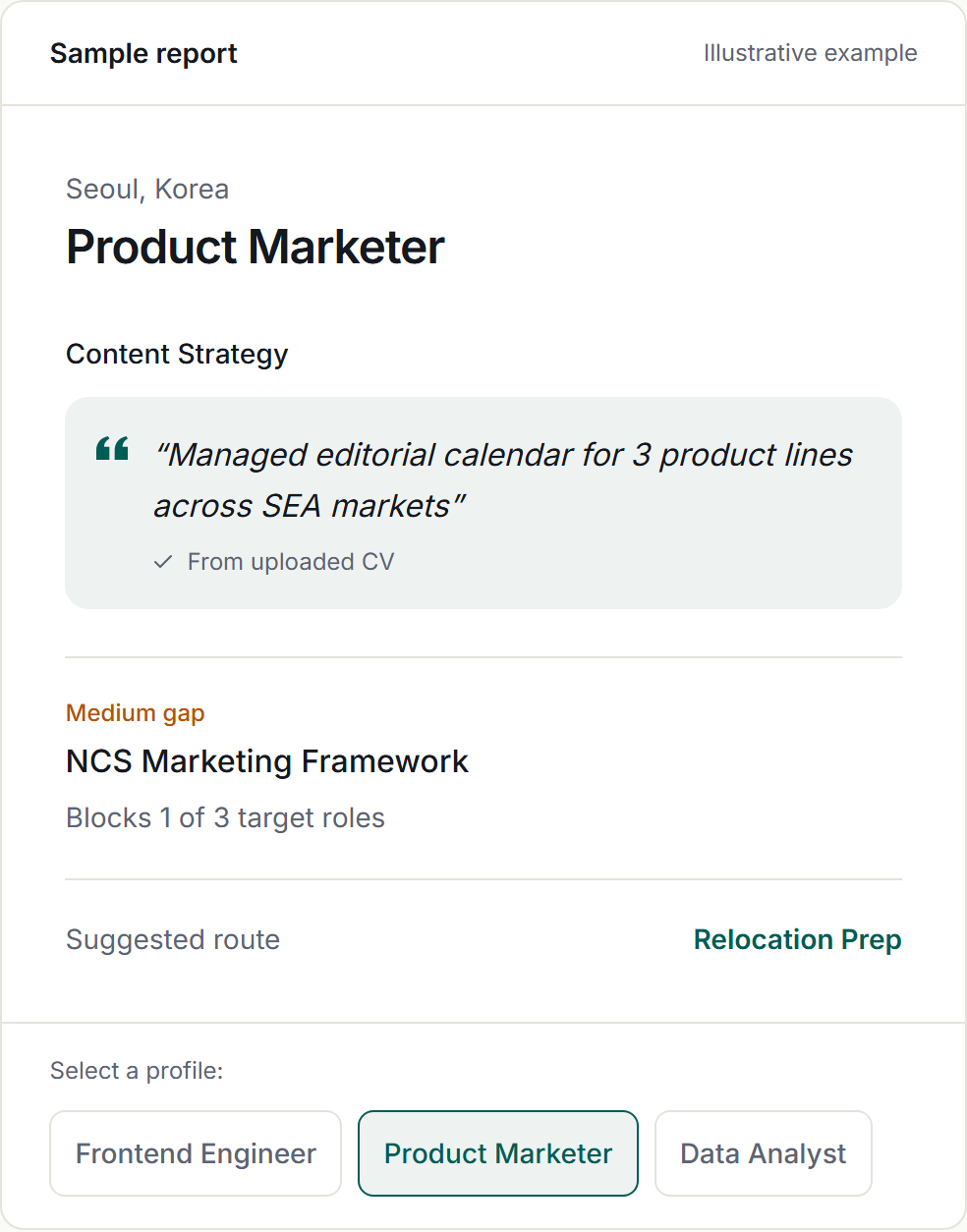
No. SkillRoute turns your CV into skills backed by quotes from your own text and flags gaps, so you know which lines to prove. You write the document yourself.
Related Articles
Map your skills and gaps
Before applying to roles in Korea or Japan, get a clear report of your verified skills and the exact gaps between you and the jobs you want.
Start freeSources
Official pages this guide was checked against on October 25, 2026. Rules change, so confirm on the official page before you apply.