How to Get a Job in Korea 2026: Visa, D-10, Pay Floor
How foreigners get hired in Korea in 2026: why the employer files your E-7, the pay floors, the 3-year D-10 job-seeker visa and the 2025 fast tracks.

By the SkillRoute Editorial Team · Last updated October 23, 2026
These guides are for educational purposes and do not constitute legal or immigration advice.
- For a professional job, a Korean employer has to sponsor you. The usual visa is E-7, and in 2026 an E-7-1 role must pay at least ₩31.12 million a year.
- You can search from inside Korea on a D-10 job-seeker visa. Since 29 October 2025 it runs up to 3 years.
- D-10 needs a bachelor's degree and enough points, unless you qualify for an exemption.
- Two 2025 fast tracks help graduates of top-200 universities and Korean-studies majors with TOPIK level 6.
Most guides on how to work in Korea as a foreigner are lists of job boards. This one explains the process behind the listings, because the process decides who gets a reply.
Every rule below comes from a Ministry of Justice (MOJ) document or a Korea Immigration Service guide, checked on 23 October 2026. We list no jobs and name no recruiters.
Can a foreigner get a job in South Korea?
Yes, with a sponsor. Professional work needs a work visa tied to a Korean employer, usually E-7, and the employer must be willing to file for you before you arrive.
Our Korea work visa guide maps the full route. The Korea Immigration Service says the first step from job seeking to professional work is simply this:
각 체류자격에 맞는 취업 요건 충족 (Meet the employment requirements of the relevant visa status)
Why do so many foreign applicants hear nothing back?
Our reading, not an official finding: a Korean employer has to clear a pay floor and a degree check before it can hire you. A role that cannot clear them is closed to you, however good your CV.
What are the main ways in?
Three routes cover most professionals: hired from abroad onto E-7, searching in Korea on D-10, or one of the 2025 fast tracks. Each one ends at the same place, a sponsored job.
| Route | Who it fits | What decides it |
|---|---|---|
| Hired from abroad onto E-7 | You already have an offer | The employer's filing and the 2026 pay floor |
| D-10 job seeker | You want to search and interview in Korea | A bachelor's degree and points, or an exemption |
| 2025 fast tracks | Graduates of top-200 universities, TOPIK 6 Korean-studies majors | Age 29 or under and the exact category |
What must the job pay?
An E-7-1 professional job must pay at least ₩31.12 million a year in 2026. Semi-professional and general skilled roles have a lower floor of ₩25.89 million, according to MOJ notice 2025-406.
전문인력(E-7-1) 연 3,112만원 이상 (Professional workers, E-7-1: at least ₩31.12 million a year)
| Sub-type | Minimum annual salary (2026) | Per month (our division by 12) |
|---|---|---|
| E-7-1 professional | ₩31.12 million | about ₩2.59 million |
| E-7-2 semi-professional | ₩25.89 million | about ₩2.16 million |
| E-7-3 general skilled | ₩25.89 million | about ₩2.16 million |
For example, take an illustrative offer, not a real one: ₩30 million a year for an E-7-1 role. That is below the ₩31.12 million floor, so the employer would have to raise the contract pay before it could file.
In practice, ask in the first call whether the company has sponsored a foreign hire before. The answer tells you how much of the visa process it already knows.
The notice also says some occupations follow a different standard set by the Minister of Justice, so the floor for your exact job code may differ. Our E-7 visa guide explains how to check.
How does the D-10 job-seeker visa work now?
D-10 lets you stay while you look for professional work. Since 29 October 2025, the MOJ says, you can hold it for up to 3 years instead of 2.
기존 구직(D-10) 비자로 2년만 체류가 가능한 것을 3년으로 확대하고 (The stay possible on the existing D-10 visa, previously only 2 years, is extended to 3 years)
- Each grant is 1 year instead of 6 months, up to 3 years in total.
- The cap on total internship time is lifted. One company can host you for up to 1 year, up from 6 months.
- The general route asks for a bachelor's degree or higher and enough points, per the Visa Navigator.
The Visa Navigator is dated December 2022, so its internship limits are out of date. Use the 2025 release for those and the Navigator only for the degree-and-points rule.
The points pass mark is not stated in the three documents we checked. Ask the Immigration Contact Center (1345) or read the HiKorea manual for your status before you apply.
Who qualifies for the 2025 fast tracks?
Graduates aged 29 or under from a world top-200 university, and Korean-studies majors with TOPIK level 6, skip the D-10-1 points test and the funds check. This is a 2-year pilot, the MOJ says.
| Category | Benefit |
|---|---|
| Type 1: top-200 university graduate, any major | D-10-1 points and funds requirements waived; E-7 degree and experience requirements waived |
| Type 2: Korean-studies major, TOPIK 6 | Same as type 1 |
| Type 3: science or engineering graduate of a QS top-1,000 university in one of 9 Asian countries | 20 bonus points on D-10-1; E-7 experience requirement waived |
The nine countries in the release are Vietnam, China, Thailand, Japan, India, Indonesia, Malaysia, Singapore and the Philippines. Type 3 also asks for TOPIK level 2 equivalent Korean.
The same release creates a K-Trainee company internship (D-4-2K) for students sponsored by a Korean firm. It lasts up to 6 months plus 1 month, extendable to 1 year, and it does not allow other work.
A firm may invite interns up to 10% of its permanent staff at a site, with no more than 100 at once, according to the same release.
How should you run your search?
Work backwards from the visa with this method. Decide which route you can actually use, then spend your time on employers that can sponsor it.
- Pick your route from the table above: offer from abroad, D-10 search, or a fast track.
- Find your sub-type's 2026 pay floor and refuse to chase roles below it.
- Match your degree to the job. Write down the dated evidence for any experience that bridges a gap.
- Build one CV line per skill, each backed by a result you can verify. Our Korean resume guide shows what employers may and may not ask for.
- Confirm the details with immigration (1345) before you pay for flights or fees. Once you have an offer, read Korean work culture for the legal baselines on hours, pay and leave.
All figures were verified against the MOJ press release, the MOJ wage notice and the Visa Navigator, as of 2026-10-23.
One limitation: the fast tracks are pilots and the pay floor is reset each year, so a newer notice may replace these figures. For teaching jobs, which follow their own visa, see our guide to teaching English in Korea.
Frequently Asked Questions
Can a foreigner get a job in South Korea without speaking Korean?
The documents we checked set no general Korean requirement for E-7. TOPIK matters for some D-10 exemptions and fast tracks, so your route decides whether you need it.
What visa do I need to work in Korea?
Most professionals need E-7, applied for with a sponsoring Korean employer. D-10 lets you stay and look for that employer, and teachers use a separate visa.
How long can I stay in Korea on a D-10 visa?
Up to 3 years since 29 October 2025, granted 1 year at a time. Before that date the maximum was 2 years in 6-month grants.
What is the minimum salary for an E-7 visa in 2026?
₩31.12 million a year for E-7-1, ₩25.89 million for E-7-2 and E-7-3. Some occupations follow a different standard set by the Minister of Justice.
Is there a faster route for graduates of top universities?
Yes, a 2-year pilot. Graduates aged 29 or under from a world top-200 university skip the D-10-1 points test and the funds check, and E-7 degree and experience rules are waived.
Does SkillRoute list jobs in Korea?
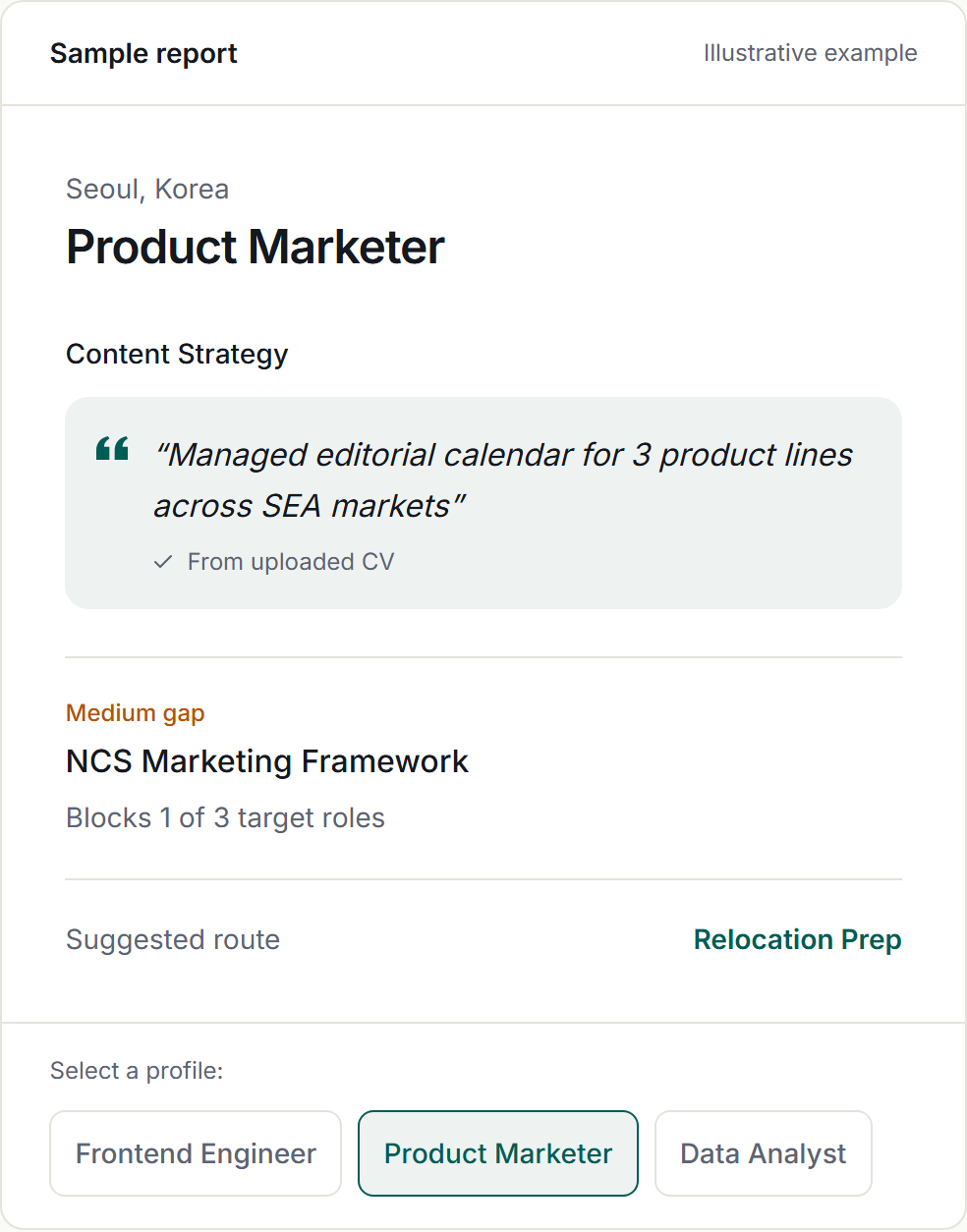
No. SkillRoute does not list jobs. It turns your CV into skills with evidence and suggests routes, so you know what to apply for.
Related Articles
Map your skills and gaps
Before applying to roles in Korea or Japan, get a clear report of your verified skills and the exact gaps between you and the jobs you want.
Start freeSources
Official pages this guide was checked against on October 23, 2026. Rules change, so confirm on the official page before you apply.