Work in Japan for Foreigners: A 2026 Guide for Job Seekers
How foreigners can work in Japan in 2026: the main office visa, the COE process, J-Find, Japanese-level demand and how to avoid unverified agency promises.

By the SkillRoute Editorial Team · Last updated October 16, 2026
These guides are for educational purposes and do not constitute legal or immigration advice.
- A work visa needs a degree or qualifying work experience related to the job, judged against ISA criteria.
- Your employer or an authorised agent can file for your Certificate of Eligibility (COE).
- The ISA lists standard COE processing as one to three months.
- In a 2025 JETRO survey, the top reason firms gave for hiring highly skilled foreign staff was multilingual ability. Over 70% of those firms want business-advanced Japanese or higher.
Foreign workers in Japan hit a record at the end of October 2025. Japanese employers are hiring more overseas staff each year.
A job offer is only one step. However, you also need a matching visa, papers that prove your background, and a clear view of the Japanese level employers want.
How many foreign workers does Japan employ?
The Ministry of Health, Labour and Welfare counted 2,571,037 foreign workers at the end of October 2025. That is 268,450 more than a year earlier. It published the data on 30 January 2026.
外国人労働者数は2,571,037人で前年比268,450人増加し、届出が義務化された平成19年以降、過去最多であり、対前年増加率は11.7%と前年の12.4%から0.7ポイント減少。
In English: foreign workers numbered 2,571,037, up 268,450 on the year before. It is the highest total since reporting became mandatory in 2007. Growth slowed from 12.4% to 11.7%.
What visa lets foreigners work in an office or tech job?
Many office, engineering and translation jobs use the Engineer / Specialist in Humanities / International Services visa. The Immigration Services Agency (ISA) sets its rules.
Your duties must match your background. The ISA asks for proof of a university-level education or equivalent. It also accepts an employment certificate for related work. Some fields have extra rules.
Your degree should relate to the work you will do. Read the Japan work visa guide and the ISA criteria for your job before you apply.
| Item. | What the ISA page says. | Why it matters. |
|---|---|---|
| Education proof. | Graduation certificate or equivalent education. | Shows your background fits the duties. |
| Experience proof. | Employment certificate covering related work. | Offers another route if you lack a degree. |
| Period of stay. | 5 years, 3 years, 1 year or 3 months. | The length is set at approval. |
| Working conditions. | A written conditions document is required. | Confirms duties, hours and pay terms. |
Can you get a job in Japan without speaking Japanese?
Some roles use English, but many employers expect Japanese. Check each job post for the level it names. Do not assume English is enough.
JETRO surveyed Japanese firms on overseas business in 2025. The most common reason for hiring highly skilled foreign staff was multilingual ability. Over 70% of those firms want business-advanced Japanese or higher.
Treat Japanese study as part of your job search. In practice, even an English-language role leaves daily life and paperwork in Japanese.
How does the Certificate of Eligibility process work?
The Certificate of Eligibility (COE) is issued by immigration in Japan. You get it before you apply for a visa abroad. It shows your planned work meets the status criteria.
The ISA lists who may file: the applicant, staff of the receiving organisation, or an authorised agent. In most hires, employer staff or an authorised agent file it.
The ISA gives a standard processing time of one to three months. Plan your move around that range. Missing papers can add delays.
For example (illustrative only): a candidate accepts an offer in March. The employer files the COE. The candidate should not book a flight until the COE arrives.
What is the J-Find visa for graduates?
J-Find is a Designated Activities status. It is for graduates of top universities who want to look for work in Japan.
The ISA page lists a stay of up to two years. You must have graduated within five years. Your university must rank in the top 100 in at least two of three rankings.
You also need at least ¥200,000 in savings when you apply. Read the ISA J-Find page for the list of qualifying rankings.
How do Japanese job applications differ from Western CVs?
Traditional Japanese hiring uses two documents. The rirekisho is a personal history form. The shokumu keirekisho is a work history summary.
Check each job post for the format it wants. For instance, global firms often take a standard resume. Our Japanese resume guide explains both documents and how to fill them in.
How can you avoid unverified recruitment promises?
Be wary of anyone who asks for money before an interview. Be wary of visa promises too. Confirm the company exists. Ask for a written contract with duties, hours and pay.
Get the visa route in writing. If a promise differs from the ISA criteria, ask which status and documents the employer plans to use.
How should you prepare before you apply?
Build proof employers can check. Gather a clear resume, translated degree papers, employment certificates and language test results. Papers that can be checked ease doubt.
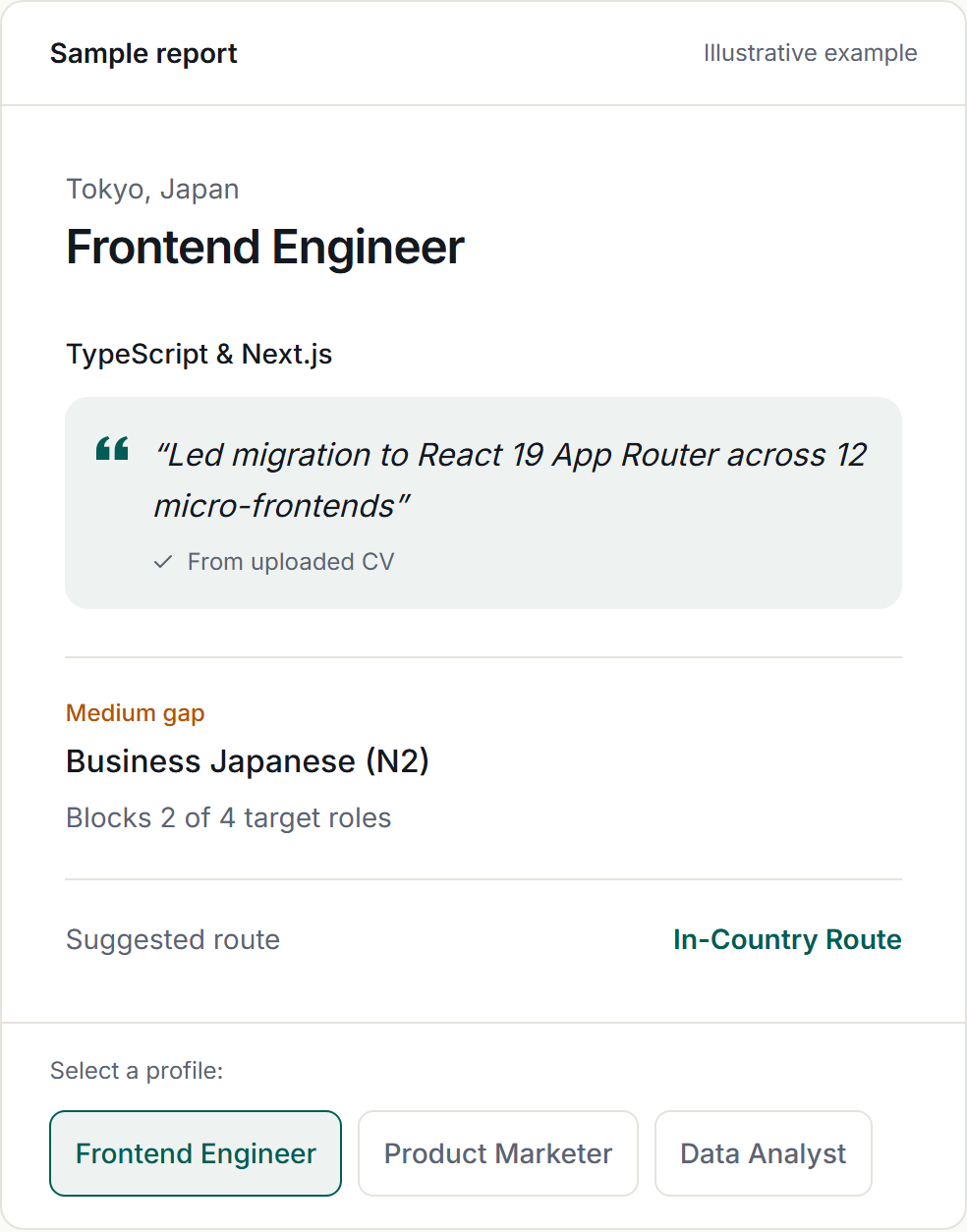
Map your skills to the roles you want before you apply. A short skills interview shows where you are strong and where employers may ask for more.
Frequently Asked Questions
Can I look for a job in Japan on a tourist visa?
A Temporary Visitor stay is not a work status. Plan to receive your COE and work visa before you move, and check the ISA before you travel.
Is a degree required to work in Japan?
Not always. The ISA accepts a university-level education or equivalent. It also accepts proof of related work. Rules vary by job, so check the ISA criteria.
Who files the Certificate of Eligibility?
The ISA lists the applicant, staff of the receiving organisation, or an authorised agent. In most hires, the employer's staff or an authorised agent files it.
How long does the COE take?
The ISA gives a standard processing time of one to three months. Your own case may take longer if documents are incomplete.
How long can I stay on an Engineer / Specialist visa?
The ISA lists periods of stay of 5 years, 3 years, 1 year or 3 months. Immigration sets the period when it approves your status.
What is the J-Find visa?
It lets graduates of top-ranked universities look for work in Japan. The stay is up to two years. Check the ISA page for the full criteria.
Related Articles
Map your skills and gaps
Before applying to roles in Korea or Japan, get a clear report of your verified skills and the exact gaps between you and the jobs you want.
Start freeSources
Official pages this guide was checked against on October 16, 2026. Rules change, so confirm on the official page before you apply.
- Ministry of Health, Labour and Welfare: foreign workers in employment report, end of October 2025.
- Immigration Services Agency: Engineer / Specialist in Humanities / International Services.
- Immigration Services Agency: Certificate of Eligibility procedures.
- Immigration Services Agency: Designated Activities (J-Find).
- JETRO: 2025 survey of Japanese companies' overseas business.