Japanese Job Interview 2026: Questions, Etiquette and Rules
How Japanese job interviews work in 2026: typical question stages, MHLW fair recruitment rules, common etiquette practices, and expected language standards.

By the SkillRoute Editorial Team · Last updated October 17, 2026
These guides are for educational purposes and do not constitute legal or immigration advice.
- A Japanese job interview checks your skills for the role and how you communicate with a team.
- The labour ministry asks employers to avoid personal questions on birth roots, home life, and faith.
- Common room manners include knocking three times, greeting the room, and waiting to sit.
- Structure your self-intro with your name, core craft, one clear win, and your goal in two minutes.
A japanese job interview tests your hard skills and your daily speech. Hiring teams check how your skills fit the role. They also check how you explain your work to colleagues.
The Ministry of Health, Labour and Welfare (MHLW) publishes fair recruitment guidance for employers in Japan. Knowing it helps you prepare, and helps you spot questions that fall outside it.
How is a Japanese job interview structured?
A standard job interview has four clear parts. You start with a short self-intro. The team then asks about your past work and your aims. At the end, you ask your own questions.
First rounds are screening calls with HR staff. They check your basic speech and culture fit. For technical roles, second rounds often involve future teammates who review your technical work.
Final rounds take place with department heads or executives. In practice, these senior leaders check your long-term drive. They also check how you fit the company roadmap.
Which topics does the labour ministry ask employers to avoid?
The labour ministry asks employers to focus strictly on job aptitude. It asks interviewers to avoid questions on family roots, birthplace, housing, religion, and political views.
According to the MHLW fair recruitment portal, selection should respect the applicant's basic human rights and use criteria based on aptitude and ability.
適性・能力に関係のない事項は、それを採用基準としないつもりでも、応募用紙に記載させたり面接時にたずねたりすれば、その内容は結果としてどうしても採否決定に影響を与えることとなり、就職差別につながるおそれがあります。
In translation, the ministry says asking about matters outside job aptitude affects hiring choices. It warns that this can lead to hiring discrimination.
On its recruitment considerations page, the ministry lists 14 sensitive matters. These include family assets, home layout, personal faith, and political views.
What room etiquette is common practice in Japan?
Common room manners include knocking three times, greeting the room, and waiting for an invitation to sit. Exact customs vary between traditional firms and modern tech teams.
- Knock three times on the closed door. Wait until the host invites you in.
- Open the door and say excuse me (失礼します, shitsurei shimasu). Step in and shut the door quietly.
- Bow politely toward the panel before you walk to your seat.
- Stand beside the chair until the lead host invites you to sit down.
Place your bag on the floor next to your chair leg. Keep your back straight. Rest your hands gently on your lap and look at the person speaking.
When the talk ends, stand up by your chair. Say thank you very much (ありがとうございました, arigatou gozaimashita). Bow politely and walk to the exit.
How should you structure your self-introduction in Japanese?
Structure your self-intro with your name, your core craft, one clear achievement with numbers, and your motivation in under two minutes.
Hello Work describes the career history document (職務経歴書) as the place to show concrete career detail and motivation that a resume cannot hold. Your self-intro can draw on the same material.
In an illustrative example, an engineer says one database fix cut page load times, then names the tools used. Avoid reading your entire CV aloud.
What questions do Japanese interviewers ask most often?
Hiring managers ask why you chose their firm and why you picked Japan. They also ask how you solved a hard project obstacle and how you work in a team.
| Question Group | Common Prompt | Recommended Response Focus |
|---|---|---|
| Company Motivation | 志望動機 (Shibou douki) | Explain why this firm and its product fit your career path. |
| Self Promotion | 自己PR (Jiko PR) | Highlight one primary craft backed by clear project metrics. |
| Relocation Purpose | なぜ日本なのか (Naze Nihon na no ka) | Explain how work in Japan fits your long career aims. |
| Problem Resolution | 困難を乗り越えた経験 | Show your approach to solving a hard roadblock with your team. |
| Reverse Question | 逆質問 (Gyaku shitsumon) | Ask about team goals, sprint cadence, or tech stack plans. |
When preparing your company motivation (志望動機), explain why you picked this firm instead of rivals. Mention specific parts of their product, team mission, or tech choices.
Before you interview, check your visa options in our Japan work visa guide, and format your paperwork using our Japanese resume guide.
Which Japanese language level is expected in interviews?
Language needs vary by firm. Global tech teams often run interviews in English. Many domestic firms look for clear, polite Japanese more than advanced honorifics (keigo).
A JETRO survey found that securing multilingual staff is the most common reason firms hire highly skilled foreign workers. Over 70% of the firms giving that reason want business-advanced Japanese or higher.
For most technical jobs, daily polite speech (丁寧語: desu and masu) is widely used. Clear words and good listening often matter more than advanced honorifics.
How should you prepare reverse questions for the interviewers?
Prepare two or three thoughtful questions on team workflow, project priorities, or code review practices. This shows real interest in how the team builds software.
At the end of the talk, interviewers usually ask if you have questions (逆質問, gyaku shitsumon). Saying you have none can read as low interest.
Good topics include asking how the team balances new features with technical debt. You can also ask what goals a new engineer should hit in their first quarter.
How can you check your interview readiness before applying?
Check your interview readiness by comparing your CV claims against real employer expectations. Make sure each claimed skill and project outcome is confirmed by clear evidence.
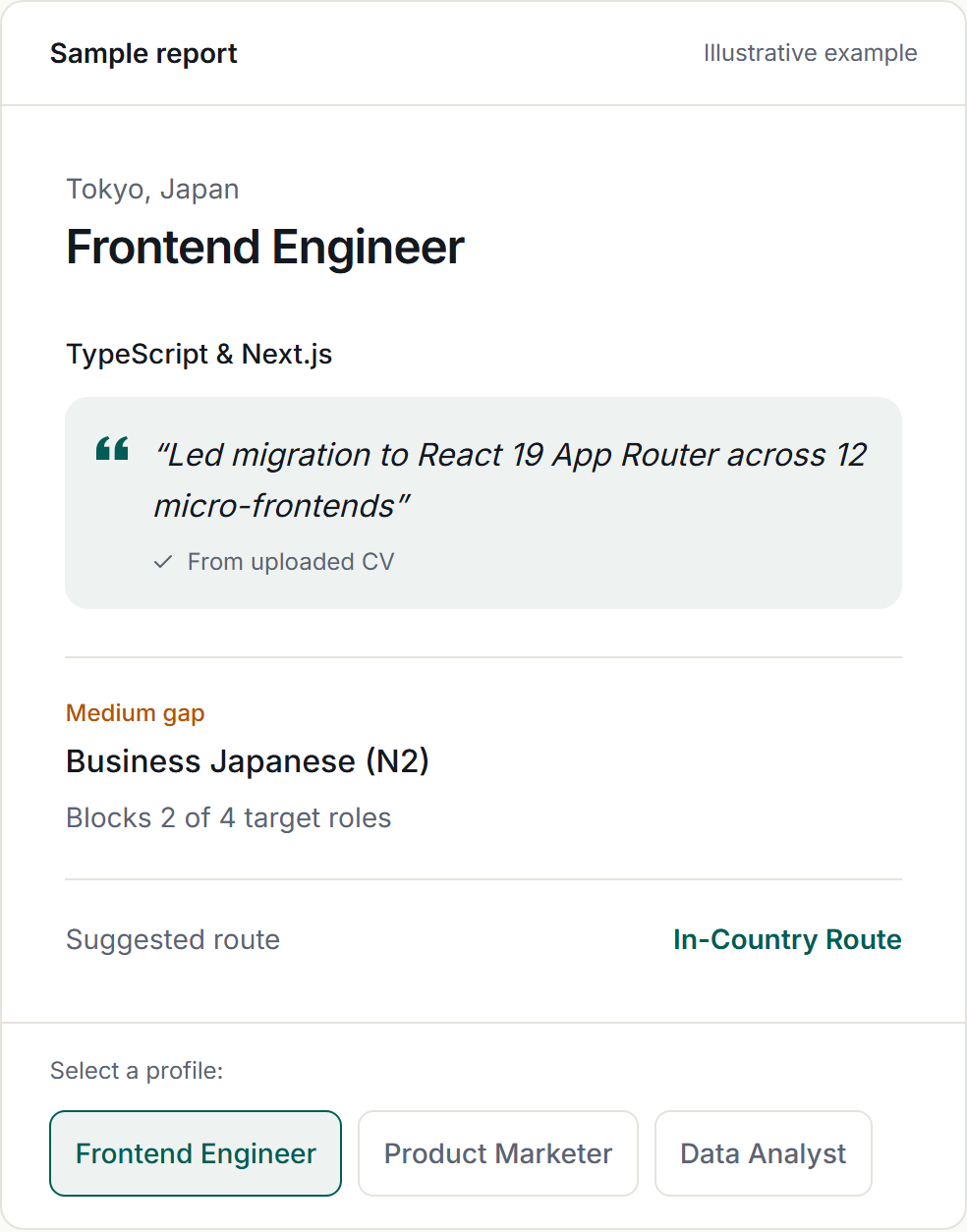
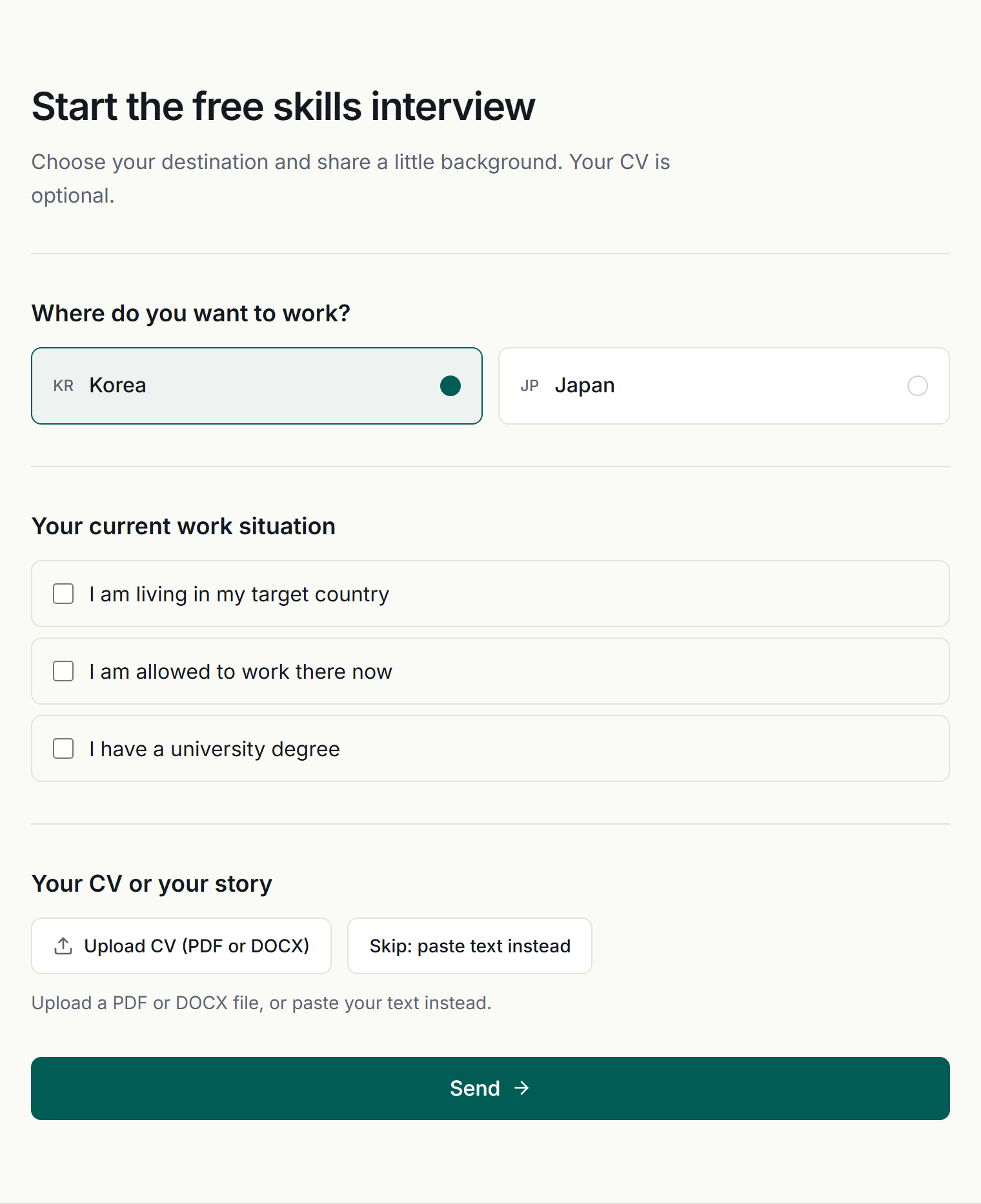
The free SkillRoute skills interview asks about your work and builds a report from your own answers. It shows which skills you can back with evidence and where the gaps are.
Frequently Asked Questions
How many times should I knock on the interview door in Japan?
Three knocks is common practice at many Japanese firms, though customs vary. Wait until an interviewer invites you inside before turning the door handle.
Can Japanese employers ask about my family or marriage plans?
The Ministry of Health, Labour and Welfare asks employers to avoid personal questions about family, marriage, or private faith to keep selection fair.
What attire is appropriate for a Japanese job interview?
A dark business suit is traditional for corporate roles. For tech start-ups, neat smart-casual wear is often accepted. Ask the recruiter if you are unsure.
Do I need fluent Keigo honorifics to pass an interview in Japan?
Not usually. Clear polite speech with desu and masu is widely used, though requirements vary by firm and role.
What should I do if I do not understand an interview question in Japanese?
Politely ask the interviewer to repeat or rephrase the question. Asking for clarity shows good listening and calm focus.
Related Articles
Map your skills and gaps
Before applying to roles in Korea or Japan, get a clear report of your verified skills and the exact gaps between you and the jobs you want.
Start freeSources
Official pages this guide was checked against on October 17, 2026. Rules change, so confirm on the official page before you apply.
- Ministry of Health, Labour and Welfare: Principles of Fair Recruitment and Selection
- Ministry of Health, Labour and Welfare: Matters to Consider in Recruitment Selection
- Hello Work: Application Document Guidance (Resume and Career History)
- Japan External Trade Organization (JETRO): Survey on International Business Operations