D-10 Visa Korea 2026: Points, Exemptions, Internships
What the D-10 job seeker visa allows since 29 October 2025: 1-year grants up to 3 years, the 60-point pass mark, who skips the test and how internships count.

By the SkillRoute Editorial Team · Last updated October 26, 2026
These guides are for educational purposes and do not constitute legal or immigration advice.
- D-10 is South Korea's job seeker visa. It lets you stay while you look for a professional job (E-1 to E-7) or do an internship.
- Since 29 October 2025, each grant runs 1 year and the total stay can reach 3 years. Before that it was 6 months at a time, up to 2 years.
- Most applicants need a bachelor's degree and enough points. The Korean government's embassy checklist gives the pass mark as 60 points.
- Graduates of Korean universities with TOPIK level 4 skip the points test. Some foreign graduates get a points exemption or a 20-point bonus.
Most guides to the D-10 visa were written before October 2025. They still say 6 months and 2 years. This guide uses the Ministry of Justice (MOJ) press release and the Korea Immigration Service's own visa manual, checked on 26 October 2026.
Everything here is current as of 2026. The limits of what we could confirm are marked in the text.
What is the D-10 visa in Korea?
D-10 is the job seeker status of residence. It covers looking for work, preparing a tech start-up, or interning in an advanced-technology field, according to the Korea Immigration Service's Visa Navigator.
Your target decides which kind of D-10 you apply for. The general job seeker type (D-10-1) leads to the professional work visas, E-1 to E-7. Our Korea work visa guide shows where that path ends.
취업을 위한 구직활동, 기술창업 준비 또는 요건을 갖춘 기업에서 첨단기술 (Job hunting for employment, preparing a technology start-up, or interning in advanced technology at a qualifying company)
How long can you stay on a D-10 visa now?
You can now stay up to 3 years on D-10, in grants of 1 year each. We confirmed in the MOJ press release, which says the rule took effect on 29 October 2025. Before, it allowed 6 months per grant and 2 years in total.
| Rule | Before 29 Oct 2025 | From 29 Oct 2025 |
|---|---|---|
| Length of each grant | 6 months | 1 year |
| Total job-search stay | 2 years | 3 years |
| Total internship time | 1 year in all | No overall cap |
| Internship at one company | 6 months | 1 year |
The MOJ lifted the overall internship cap because an internship counts as part of the job search. It kept a 1-year limit at any single company. Its stated reason was low-wage labour concerns.
Who is eligible for the D-10-1 job seeker visa?
You usually need a bachelor's degree or higher and a plan to work in an E-1 to E-7 field. The Korean embassy checklist names three groups: Global 500 ex-employees, top-200 university graduates, and Korean college graduates.
- A former employee of a Fortune Global 500 company for more than 1 year within the last 3 years.
- A graduate of a university in the top 200 of the Times Higher Education World University Rankings.
- A graduate of a Korean community college or higher.
The checklist also says short-term paid internships can count as training. The visa is for people who plan to work in E-1 to E-7 fields: professor, language instructor, researcher, technician, professional, artist or athlete, and specially designated activities.
How many points do you need for D-10?
The embassy checklist says D-10-1 needs a minimum of 60 points, scored on factors such as education, age and Korean ability. We could not find the full score table on an MOJ page, so confirm it with the immigration office. That is the main limitation of this guide.
Neither the MOJ release nor the embassy checklist publishes approval statistics, so treat any pass rate quoted elsewhere as unverified.
This visa requires a minimum of 60 points based on factors such as education, age, and Korean language proficiency
Korean ability is the item you can still change. Our TOPIK guide shows which level matters for each route, and book the next sitting early because results take weeks.
Who skips the points test or gets bonus points?
Three groups get special treatment. Korean university graduates with TOPIK level 4 skip the points test. Foreign top-200 graduates under 30 skip it and the funds check. Some science graduates get 20 bonus points.
| Group | What they get | Condition |
|---|---|---|
| Korean university graduates | Points test waived | Associate degree or above within the last 3 years, plus TOPIK level 4 or a social integration programme result |
| Foreign graduates, type 1 and 2 | Points test and financial requirement waived | Aged 29 or under; top-200 world university (any major), or Korean-studies major with TOPIK level 6 |
| Foreign graduates, type 3 | 20 bonus points on the D-10-1 score | Aged 29 or under; science or engineering degree from a QS top-1,000 university in one of 9 Asian countries; TOPIK level 2 equivalent |
The two foreign-graduate routes are a 2-year pilot. The 9 countries are Vietnam, China, Thailand, Japan, India, Indonesia, Malaysia, Singapore and the Philippines. The MOJ will decide after the pilot whether to expand it.
구직(D-10-1) 비자 가점(20점) 부여 (D-10-1 visa: 20 bonus points awarded)
What can you do on a D-10 visa besides look for a job?
You can intern. Since October 2025 there is no cap on total internship time, and one company can host you for up to 1 year. The MOJ says this reflects that internships are part of looking for work.
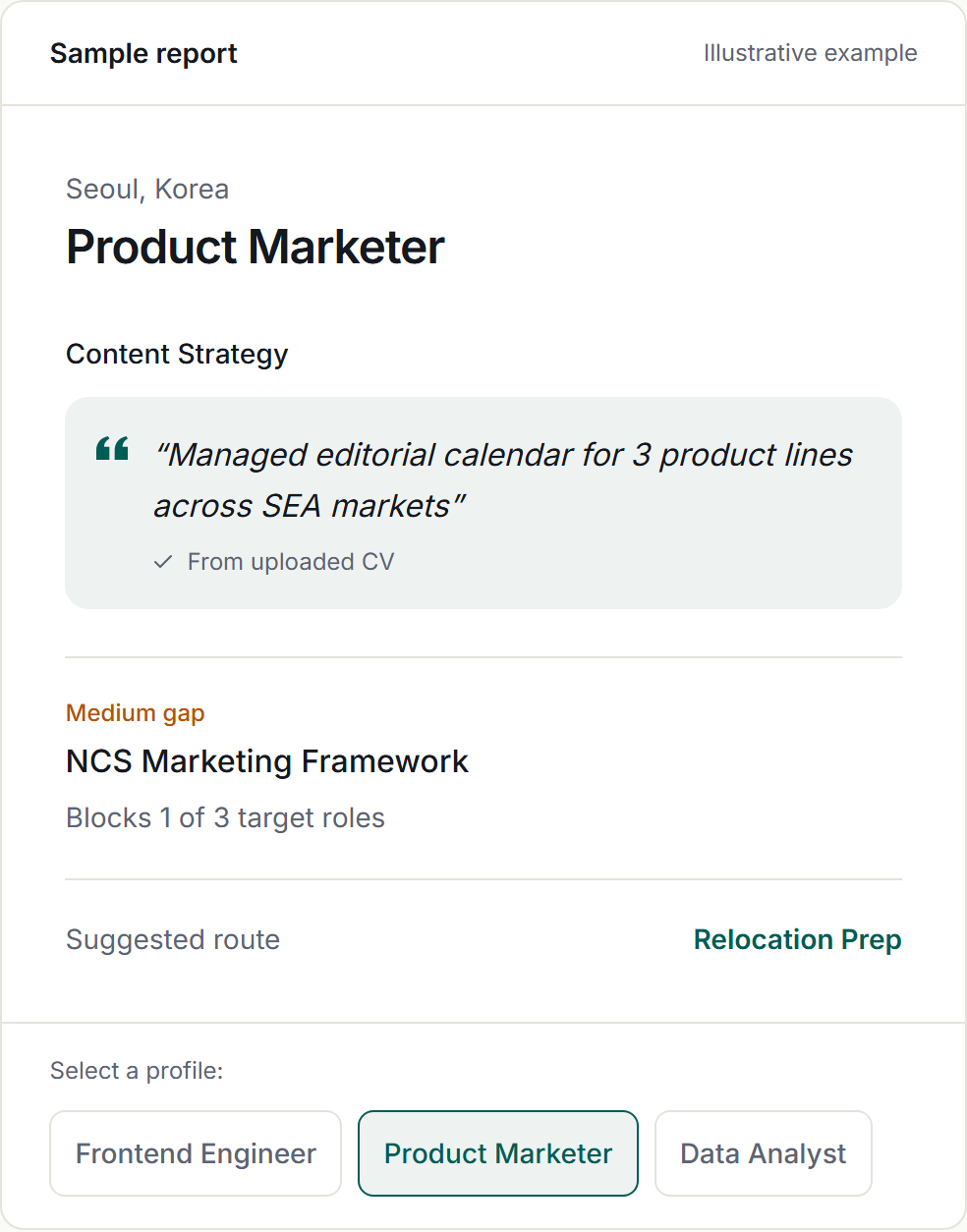
In practice, treat the internship as a trial for E-7 sponsorship. For example, an illustrative applicant interns 8 months at a Seoul software firm, then asks it to sponsor an E-7-1. The firm already knows their work, which shortens its decision.
Your CV should show what you can already do. Our Korean resume guide covers the format, and the guide to getting a job in Korea covers the search itself.
What happens when your D-10 grant is running out?
You switch to a work visa before the final grant ends, so plan the sponsor search from month one. The process starts with your employer, who applies on your behalf for E-7. The officer then checks your degree against the job.
Frequently Asked Questions
How long is the D-10 visa valid in Korea?
Since 29 October 2025, each D-10 grant lasts 1 year and the total stay can reach 3 years, according to the Ministry of Justice. Before that it was 6 months at a time, up to 2 years.
How many points do I need for the D-10-1 visa?
The Korean embassy checklist says a minimum of 60 points, based on education, age and Korean ability. We found no MOJ score table, so confirm the scoring with the immigration office.
Can I do an internship on a D-10 visa?
Yes. Since October 2025 there is no cap on total internship time, and a single company can host you for up to 1 year instead of 6 months.
Do I need TOPIK for the D-10 visa?
Not always. TOPIK level 4 lets Korean university graduates skip the points test, and it adds points for others. The foreign-graduate 20-point bonus needs a level 2 equivalent.
Is a degree required for the D-10 visa?
Generally yes. The Visa Navigator asks for a bachelor's degree or above, and Korean associate degrees count. The embassy checklist says it normally requires at least a bachelor's degree.
Can I switch from D-10 to an E-7 work visa?
Yes. D-10 is built as the first step toward E-1 to E-7 work visas. Your employer applies for the E-7, so you need a job offer before your final D-10 grant ends.
Related Articles
Map your skills and gaps
Before applying to roles in Korea or Japan, get a clear report of your verified skills and the exact gaps between you and the jobs you want.
Start freeSources
Official pages this guide was checked against on October 26, 2026. Rules change, so confirm on the official page before you apply.